NIC Excellence Project 2025/2
FRONTAIR – Pushing the frontiers of air composition modelling
John von Neumann Excellence Project 2025/2
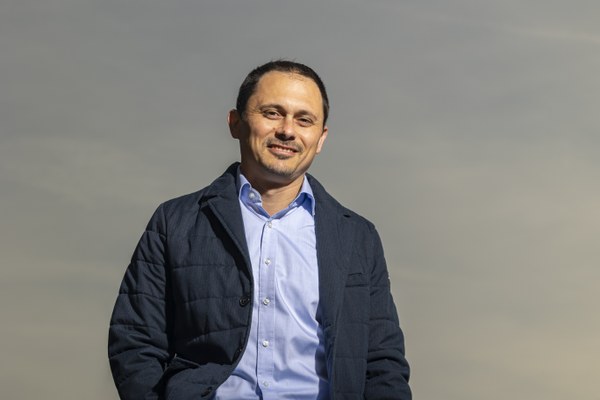
Dr. Domenico Taraborelli (Forschungszentrum Jülich / ICE-3)
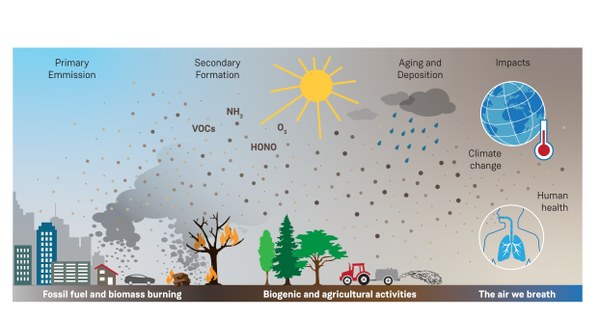
Air composition is crucial for planetary health and climate. However, advancing the understanding of the key chemical transformations requires the development of complex multiphase kinetic models whose numerical integration is a very stiff problem. Consequently, accounting for the “chemistry” within Earth System Models can be computationally prohibitive. Under these premises the FRONTAIR project was started with support from the HGF ESM project and the availability of the ESM partition on JUWELS. The initial focus was on the transport and processing of pollution to the stratosphere in the Asian Monsoon region (Rosanka et al. (2021); Becker et al. (2025))
Technical developments aimed at improving efficiency, scalability and portability of the MESSy model are a major activity within FRONTAIR. Under the impulse of the HGF ExaESM project a tool for porting individual components to GPUs and optimize performance, the MESSy DWARF, was developed. The numerical solver for large chemical ODEs has been ported to GPUs and made significantly more efficient. The GPU porting of the MESSy code continues profiting from the constant support by JSC. These developments are instrumental for the scientific focus of the project.
A remarkable achievement in FRONTAIR has been the ability to perform explicit multiphase chemistry simulations with MESSy on a global scale also for deliquescent aerosols. Such simulations require plenty of computing time and memory per node. Nevertheless, they open new avenues for advancing understanding of air pollution and its implication for human health and the lifetime of short-lived climate forcers. Currently, global simulations are being conducted with a focus on the dissolution and radical chemistry of iron from mineral dust.
In climate science, the storyline approach has recently gained momentum as an effective approach to investigating climate change and its impacts. With support from the SCENIC project the first storyline scenarios of air pollution could be developed. The first application has been investigating how surface ozone pollution and its impact on health might change in a warmer world. Within the ACTUATE project storyline simulations will be conducted to explore the role of brown carbon for the Earth Energy Imbalance and its potential for mitigation of climate change.