
NIC Excellence Project 2026/1
PROFOUND – A NIC Excellence Project on Motion-Aware Foundation Models for Protein Design
John von Neumann Excellence Project 2026/1
Dr. Alexander Schug (Karlsruher Institut für Technologie (KIT) / Scientific Computing Center)

Proteins are tiny molecular machines that keep living cells running. They help cells communicate, transport molecules, build structures, and carry out chemical reactions. Their function depends on their shape, but not on shape alone. Proteins also move: they bend, open, close, switch between different forms, and interact with other molecules. These motions are often essential for what a protein does.
Many recent AI methods for protein design focus mainly on static protein structures. This has already enabled impressive progress, but it also leaves an important gap. A protein that looks promising in a single predicted structure may still fail if it is unstable, moves in an unwanted way, or does not bind to the right partner. The NIC Excellence Project PROFOUND addresses this challenge by developing computational methods that learn from molecular dynamics simulations, computer simulations that show how proteins move over time.
The NIC Excellence Project is coordinated by Alexander Schug and focuses on the high-performance-computing and biomolecular-simulation work needed to make such approaches feasible at scale. In practice, this means using supercomputers such as JUPITER to simulate how proteins move, preparing these data for AI models, and supporting the systematic screening of promising protein candidates before they are selected for more costly laboratory experiments. Such candidates may, for example, be more likely to remain stable, bind to a desired target, or form useful molecular assemblies. The project is embedded in a large interdisciplinary team that brings together the required expertise in biomolecular simulation, high-performance computing, artificial intelligence, protein design, structural biology, and experimental validation. This team structure is essential because realistic protein design cannot rely on AI alone: it also requires physical simulations, scalable computing, robust benchmarks, biological insight, and feedback from experiments.
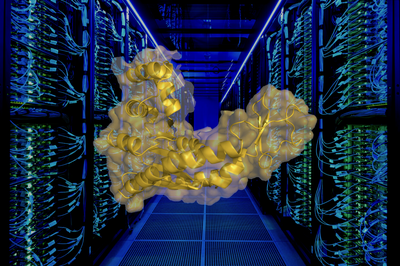
The NIC Excellence Project combines several complementary computational approaches. One part of the work collects and analyses molecular dynamics data so that protein motions can be used more systematically for AI training. Another part develops benchmarks to test whether newly designed proteins remain stable not only in a static picture, but also over time in physical simulations. Further work supports protein language models and multimodal AI models that combine different kinds of information, including protein sequences, structures, binding sites, annotations, and movement. The project also includes computational pipelines for selecting experimentally promising protein designs from very large numbers of computer-generated candidates.
High-performance computing is central to this work. Large-scale simulations and AI training require computational resources far beyond standard desktop systems. Supercomputers such as JUPITER make it possible to analyse many protein candidates, train large models, and compare alternative designs in a systematic way. In the long term, this NIC Excellence Project aims to make protein design more realistic by taking molecular motion into account. This could support future applications in medicine, biotechnology, synthetic biology, and molecular engineering, where designed proteins may be used as binders, sensors, delivery vehicles, catalysts, or building blocks for new biomolecular systems.
The NIC Excellence Project is coordinated by Alexander Schug, with substantial contributions from Alina Bazarova, Christian Faber and Emile de Bruyn to the proposal, HPC strategy, benchmark design, and computational workflows.